"Side by side with the word 'property' in the program of liberalism one may quite appropriately place the words 'freedom' and 'peace.'" Ludwig von Mises, "Liberalism, In The Classical Tradition"
Mises believed that property, freedom and peace are and should be the hallmarks of a satisfying and prosperous society. I agree. Mises proved beyond a shadow of a doubt that the prospect for general and individual prosperity is maximized, indeed, is only possible, if the principle of private property reigns supreme. What's yours is yours. What's mine is mine. When the line between yours and mine is smudged, the door to conflict opens. Without freedom (individual liberty of action) the principle of private property is neutered and the free market, which is the child of property and freedom and the mother of prosperity and satisfaction, cannot exist. Peace is the goal of a prosperous and satisfying society of free individuals, not peace which is purchased by submission to the enemies of property and freedom, but peace which results from the unyielding defense of these principles against all who challenge them.
In this blog I measure American society against the metrics of property, freedom and peace.
American singer and actress of stage, film and television...
UPDATED: Some more hints...
Ah, yes. It's Mrs. Partridge herself, Shirley Jones. A very beautiful and multi-talented lady. My wife met Ms. Jones at an airport gift shop once up close and personal. She said Shirley was more stunningly beautiful in person, not to mention gracious, friendly and down to earth. A role model for young women today.
Here's a few, more recent recordings. She will always be a grand lady.
An interview with an older Shirley Jones.
Please visit Luis' Shirley Jones Page at his wonderful website. Luis has beautiful quality photos of not only Shirley Jones, but such classic movie legends as Sophia Loren, Jacqueline Bisset, Kim Novac, Ann-Margret, Jeanne Crain, Rita Hayworth, Marilyn Monroe and many more. Don't miss it.
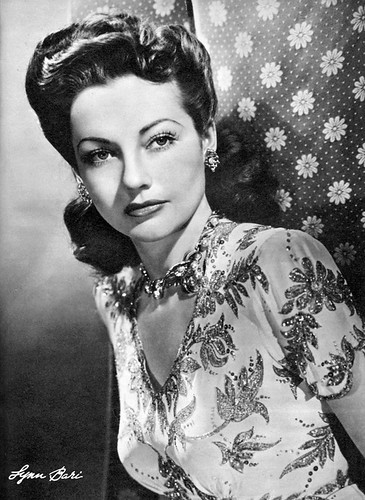
Lynn Bari is one of my favorite actresses from the black-and-white era. She played a Big Band singer in three movies: "Sun Valley Serenade" in 1941, featuring the Glenn Miller Orchestra; "Orchestra Wives" in 1942, again featuring the Miller big band; and "Sweet and Low-Down" with Benny Goodman in 1944. In all three she was the prototypical, sexy, Big Band singer/temptress. She didn't sing in the movies herself, but she had the moves down oh so well.
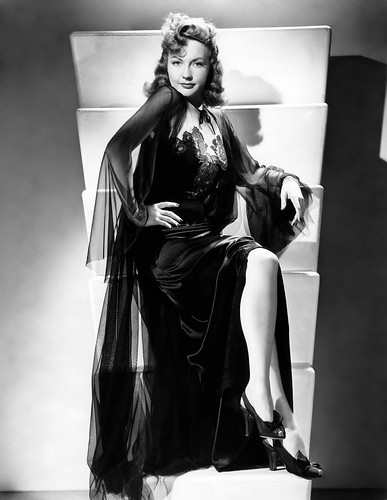
Lynn Bari (December 18, 1913 – November 20, 1989), born Margaret Schuyler Fisher, was a movie actress (usually in B-movies) who specialized in playing sultry, statuesque man-killers in over one hundred 20th Century Fox films from the early 1930s through the 1940s.[1]
In "China Girl," a favorite of mine, she plays the hard-edged woman of the world. Very, very uncomplicated. Here, from "China Girl," is a favorite scene of mine. The dialogue is stereotypical '40's, when men were men, Americans were Americans and Lynn Bari was all woman. The script was written by Ben Hecht, one of film's best screenwriters. Lynn Bari plays Captain Fifi, who along with her supposed husband, Major Bull Weed, are Japanese agents. George Montgomery plays Johnny Williams, a fast and loose American photographer/fortune hunter who is constantly on the make. Gene Tierney plays Miss Haoli Young, a "China Girl" (of Chinese/American parents). Tierney is no slouch herself when it comes to American womanhood, but it is Bari who steals this fun scene. Pay close attention to the 40's slang, the sexy banter and Johnny's description of Fifi as the woman who has "everything."
(In the hotel bar. Johnny approaches Fifi who is sitting alone at a table having a drink.)
Johnny: Sittin' up for me?
Fifi: Yeah...Momma was worried.
Johnny: Where's the Major?
F: Strolling.
(Johnny sits down with Fifi.)
F: Well, how did the romance turn out?
J: Flied out to center field.
F: Ah...you weren't yourself. What a shame. Care to tell momma about it?
J: Next Tuesday...Momma got any cash on her?
F: A little.
J: I like a girl who's solvent...Waiter! Bottle of rum! (To Fifi.) You look a little sad. You aren't homesick, are you?
F: Homesick! For where?
J: I don't know. Where you from?
F: What does it matter?
(Johnny pours a drink for himself and Fifi. She stares at him, giving him that "I like what I see and I'm available" look.He raises his glass to her.)
J: Here's to when we were young and had answers for all the questions.
F: (Dreamily) That was a nice time.
J: Yeah...Ever been up in the Wango country?
F: No.
J: They got snakes up there with great big green eyes just like yours.
F: I've done most of my crawling in warmer places.
J: I like you.
F: Snake fancier, huh?
J: No. I like you because you're everything a woman should be...a hundred and fifteen pounds of crookedness and kisses with a laugh for a finish.
F: You've got a fine sales talk, Mr. Williams.
J: Yeah. There's only one thing about a dame that's real.
F: (Leaning toward him) What's that?
J: This! (Kisses her hard)
(The two leave the lobby and head upstairs to his room. Once inside, they start getting comfortable.)
J: The principle rule is no lectures. You start that, I walk out.
F: Have it your way. (She kisses him hard. As they are kissing, he notices something in the shadows.)
J: Hold it, baby. We got a stowaway!
(Miss Haoli Young is shown lurking in the shadows.)
Young: Good evening.
J: Well! You get around a lot for a Vassar girl.
F: (Gritting teeth) Isn't this the little lady in center field?
J: Yeah, the same.
F: Outside, princess!
Y: That is for Mr. Williams to say, I think.
J: Now what is it that's on your mind, Miss Young?
Y: I want to apologize to you.
J: Is that so! For what?
Y: For letting you go.
J: (Smiles excitedly, gives Fifi a quick peck on the lips and tells her....) My duty is plain. (He turns to Miss Young and pulls her toward the door.) Come on!
F: (Angrily) True love wins, huh?
J: Yeah, something like that! (He steps through the door and into the hall with Miss Young in tow. He turns to Fifi.) Oh, give the Major my best regards, and tell him how I acted like a man of honor in a pinch!
F: (Angrily follows Johnny and Miss Young into the hall. As they flee, she growls at them.) You bore me, Mr. Williams! (She picks up the bottle of rum, hurls it at Johnny, but misses.)
J: (Tugging Miss Young as they run away) Come on, Baby! She may get the range!
Priceless! It's the reason I love old movies.
Lynn Bari's authorized biography, written by Jeff Gordon (no, not that Jeff Gordon), called "Foxy Lady," is reputed to be one of the best ever written in the genre. It's well worth the price tag.
Here's Lynn Bari as the torch singer, Vivian Dawn, in "Sun Valley Serenade." She's mouthing the words to "I Know Why." Pat Friday dubbed in the vocal. The intro is "Moonlight Serenade." By the way, that is the man himself playing his trombone, Glenn Miller, along with his band.
Here's Ray Eberle and Lynn Bari, as the wife-stealing torch singer, Jaynie, singing "At Last" fronting the Miller band in the film "Orchestra Wives." (An excellent movie, by the way!) At least Eberle is singing. Pat Friday is again dubbing the Bari vocal.
Not limiting herself to Miller, here's Bari as Pat Stirling, fronting the Benny Goodman Orchestra in the movie "Sweet and Low-Down." Yes, that is Mr. Goodman himself. Lynn's lip-sinc-ing "I'm Making Believe." This time it's Lorraine Elliot dubbing the vocal. That intro tune is Benny's theme song, "Let's Dance." And that dark-haired beauty dancing with her father is Linda Darnell.
What a glorious era! I'd give my right arm to be there now in a 40's night club listening to Benny and Bari...and dancing with Linda Darnell!
Here's Bari again with Goodman in "Sweet and Low-Down," singing "Ten Days With Baby."
Bari, again, in "Orchestra Wives," belting out "Serenade in Blue." If you don't like this, you are not breathing.
Cat fight!! Lynn stirred this mayhem up among the "Orchestra Wives." She doesn't appear in this scene, but it's fun anyway.
A couple of Lynn's other vehicles.
And now it's eye-candy time. Lynn Bari was a very beautiful woman and a classy dame!
During World War II, what kept the guys going was pinups of the girls. Pinups were plastered everywhere. Every guy had his own favorite. Here are a few of the most famous and popular:
But the girl the guys wanted to come home to was Jeanne Crain!
Jeanne was a sweetheart, the "good" Catholic girl next door. She was one of the most popular screen stars of the '40's, starring in such wartime films as "Winged Victory," "State Fair" and "Leave Her To Heaven." After the war she continued to win the hearts of American men in movies like "Margie," "Apartment For Peggy," "A Letter To Three Wives," "Cheaper By The Dozen" and "People Will Talk."
Crain was unflappable, wholesome, every man's notion of the perfect wife -- and a Republican! She and her films were nothing less than Americana. The United States was a different country then. Jeanne Crain has no peer in today's cinema. She was truly one of a kind. Rest in peace, Jeanne.
This video is dedicated to Jeanne Crain. She was born on May 25,1925 & died on Dec. 14,2003. She is one of my favorite actresses & my favorite movies of hers are "State Fair", "Apartment for Peggy", "Margie", "A Letter to Three Wives" , "Home in Indiana" & "Leave Her To Heaven". I just love her movies!!
Here is a mini biography of her life:
Jeanne Crain was born in Barstow, California, on May 25, 1925. The daughter of a high school English teacher and his wife, Jeanne was moved to Los Angeles not long after her birth after her father got another teaching position in that city. While in junior high school, Jeanne played the lead in a school production which set her on the path to acting. When she was in high school Jeanne was asked to take a screen test to appear in a film by Orson Welles. Unfortunately, she didn't get the part, but it did set her sights on being a movie actress.
After her high school career, Jeanne enrolled at UCLA to study drama. At the age of 18, Jeanne won a bit part in Fox Studio's film entitled The Gang's All Here (1943) and a small contract. Her next film saw Jeanne elevated to a more substantial part in Home in Indiana (1944) the following year, which was filmed in neighboring Kentucky. The movie was an unquestionable hit. On the strength of that box-office success, Jeanne was given a raise and star billing, as Maggie Preston, in the next film of 1944, In the Meantime, Darling (1944). Unfortunately, the critics not only roasted the film, but singled out Jeanne's performance in particular. She rebounded nicely in her last film of the year, Winged Victory (1944). The audiences loved it and the film was profitable.
In 1945, Jeanne was cast in State Fair (1945) as Margie Frake who travels to the fair and falls in love with a reporter played by Dana Andrews. Now, Jeanne got a bigger contract and more recognition. Later that year, Jeanne married Paul Brooks on New Year's Eve. Although her mother wasn't supportive of the marriage, the union has lasted to this day and produced seven children. Her 1947 was an off year for Jeanne as she took time off to bear the Brinkman's first child.
In 1949, Jeanne appeared in three films, A Letter to Three Wives (1949), The Fan (1949), and Pinky (1949). It was this latter film which garnered her an Oscar nomination as Best Actress for her role as Pinky Johnson, a nurse who sets up a clinic in the Deep South. She lost to Olivia de Havilland for The Heiress (1949). Jeanne left Fox after filming Vicki (1953) in 1953, with Jean Peters. She had made 23 films for the studio that started her career, but she needed a well-deserved change. As with any good artist, Jeanne wanted to expand her range instead of playing the girl-next-door types.
She went briefly to Warner Brothers for the filming of Duel in the Jungle (1954) in 1954. The film was lukewarm at best. Jeanne, then, signed a contract, that same year, with Universal Studios with promises of better, high profile roles. She went into production in the film Man Without a Star (1955) which was a hit with audiences and critics. After The Joker Is Wild (1957) in 1957, Jeanne took time off for her family and to appear in a few television programs. She returned, briefly, to film in Guns of the Timberland (1960) in 1960. The films were sporadic after that. In 1967, she appeared in a low-budget suspense yarn called Hot Rods to Hell (1967). Her final film was as Clara Shaw in 1972's Skyjacked (1972).
Jeanne died of a heart attack in Santa Barbara, California, on December 14, 2003. Her husband Paul Brooks had died two months earlier.
I hope you enjoy my video!!
God Bless!! Song: Stardust By: Artie Shaw & his Orchestra
And another...
And another...
Lastly, here she is appearing on live radio, hosting "Command Performance," a "weekly wartime 30 minutes of star-studded fun" made to entertain the troops...
(Featuring Harry James, Kitty Kallen, Gene Krupa et. al.)